Meetups
Phones down. Do something together. Then talk.
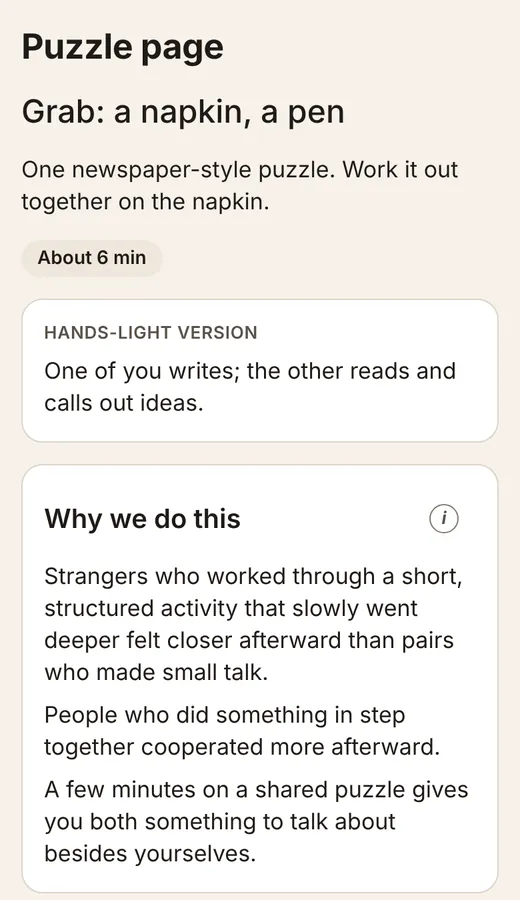
Every first meetup starts with one short activity, 5 to 15 minutes, using only what's already on the table: a napkin, a pen, coins, sugar packets, stirrers, a receipt. One phone lies on the table showing the steps in large type. Then it's on to the conversation.
Free to join. In your browser, on iPhone and on Android.
Example screen, simplified from the app.
What you might do
Newspaper-style puzzles
Riddles, codes, a number grid, word ladders, made-up definitions. The most common pick everywhere.
Parlor games, adapted
Sketch rounds, twenty questions, a folded drawing, a ten-word story. Never personal-disclosure games in hiring.
Work puzzles
Estimate a menu, sketch a process, split clues where neither half solves it alone, crack a three-digit lock.
Build together
A paper tower, a stirrer bridge, a napkin parachute. You try to beat your own first try, never each other. For second meetings, tours and job sites.

Never a test
Nothing is scored, timed against anyone, or stored beyond a minimal record that it happened. Clues come one tap at a time; answers only when you ask. There's no winner.
Either of you can tap "Something else" before you start, and nobody is told who asked. Afterward, two private questions: did you both get a say, and did it feel easy to suggest ideas?
Every activity has a hands-light version (one directs, one builds), extra time when asked, and a spoken version. No disability is ever asked.
Why we do this
A plain chat is a weak way to judge someone at work. In the largest recent review of hiring methods, unstructured interviews predicted job performance at about .19; structured interviews at .42, the top of the list (Sackett et al., 2022). We use this only to say an unstructured chat is weak. We don't claim the activities predict job performance.How people work together matters more than who is in the room. In a study of 699 people in groups of two to five, groups with evenly shared speaking turns and more social sensitivity did better; the members' individual intelligence did not significantly predict it (Woolley et al., 2010).Feeling safe to speak up comes first. In Google's study of 180+ teams, psychological safety was "far and away the most important" of five team dynamics (Project Aristotle; the concept is Edmondson's, 1999). That's why the manager or mentor goes first on anything personal.Doing something together builds closeness that small talk doesn't. A structured activity that slowly went deeper built more closeness between strangers than small talk did (Aron et al., 1997). People who moved in step with each other cooperated more afterward (Wiltermuth & Heath, 2009).Build early, then improve. In tower-building workshops, teams that built and tested early beat teams that spent their time planning (Wujec, 2010). That's workshop observation, not a controlled study, and we say so.What we left out. We found no good evidence that sitting side by side eases conversation compared with face to face, and the research doesn't show a short shared task beats a good interview question. So we don't claim either.How a meetup comes together
Pick an activity, not a conference room
The app suggests a few places both of you like, within the lower budget and anyone's access needs, at a café, an office, a job site or outdoors. Each of you ranks them privately.
Split the arrangements by taps
Who books, who picks the time, who covers the cost. No chat.
Show up and find each other
Names appear at the reveal, so ask for each other at the front desk or the site office.
One question each, one choice together
Networking and co-founder meetups add a personal question for each of you and a small decision to make together.
Sources
- Sackett, Zhang, Berry & Lievens (2022). Revisiting meta-analytic estimates of validity in personnel selection. Journal of Applied Psychology, 107(11), 2040–2068. summary via SIOP TIP
- Woolley, Chabris, Pentland, Hashmi & Malone (2010). Evidence for a collective intelligence factor in the performance of human groups. Science, 330(6004), 686–688. summary via ScienceDaily
- Google People Operations (re:Work), "Guide: Understand team effectiveness" (Project Aristotle). summary via michigan.gov
- Edmondson (1999). Psychological safety and learning behavior in work teams. Administrative Science Quarterly, 44(2), 350–383. JSTOR
- Aron, Melinat, Aron, Vallone & Bator (1997). The experimental generation of interpersonal closeness. Personality and Social Psychology Bulletin, 23(4), 363–377. citation
- Wiltermuth & Heath (2009). Synchrony and cooperation. Psychological Science, 20(1), 1–5. summary via ScienceDaily
- Wujec (2010). Build a tower, build a team. TED talk; workshop observations, not a controlled study. report via Trellis
Keep exploring
Be present. The rest follows.
Free to join. Answer the basics in a few minutes and you can be matched right away. Everything else you add makes matching better.